About
Who we are
 |
 |
Founded in 2008, the Galerie Pierre Brost specialises in old master paintings and drawings, with a particular focus on 18th-century French portraits.
For more than fifteen years, the gallery has quietly been researching and rediscovering forgotten or misattributed works, bringing several of them back into the spotlight — works now recognised by specialists and institutions.
Among them are a pastel portrait by François Boucher, another by Jean Valade, an important modello by Baron Gérard, and a preparatory drawing by Nicolas-Bernard Lépicié for his self-portrait shown at the Salon of 1777.
This work, together with the gallery’s annual exhibitions, has led to several acquisitions by prestigious institutions and private collections, in France and abroad.
The Galerie Pierre Brost has thus had the honour of contributing to the collections of institutions such as the Calouste Gulbenkian Museum, the Petit Palais, the Palace of Versailles, the Musée national de la Marine, the Château de Chenonceau, the Bibliothèque nationale de France (BnF)… and several regional museums such as Rouen, Grenoble, Mâcon, Cholet and Saint-Malo.
Visits by appointment
In Paris, by appointment
or at 26 rue du Palais de Justice, 10000 Troyes.
Phone: +33 (0)6 22 02 06 47
E-mail: pierrebrost@art-courtage.com
Brokerage
Each work has its own way of being sold
Private sales
A private sale offers exclusivity, discretion and confidentiality for the work and its sale, much appreciated by collectors, whether sellers or buyers.
For the seller, unlike at auction, a transaction that does not go through has no effect on the value of the work.
This discretion can also encourage the buyer to be more generous than at auction.
Purchase / sale
We agree on a price and we buy the work from you.
Brokerage
Brokerage means advising, then buying or selling on behalf of a private individual or a company, in order to enhance or complete a collection, grow an investment or invest in an advantageous financial placement.
We work in brokerage with a network of collectors and investors. By surrounding ourselves with skilled professionals, we have built a climate of trust with our French and international clients.
Auctions
In some cases, an auction may be the best way to buy or sell, but the market must be studied carefully before acting, as a mistake can be costly.
We work in partnership with auctioneers we have selected, each with their own methods and specialities, and we propose the auction house best suited to your project.
You thus benefit from advantageous sale fees and complete, attentive follow-up.
Investing in art: a safe placement
Advantages found in no other field
Art remains not only a safe haven but also a way to diversify one's assets, offering a high-yield placement that is less risky than financial assets.
For private individuals
Owning a work of art combines pleasure and wealth.
A work of art brings many benefits and pleasures. It decorates and furnishes our home, recalls a memory, a place, an era; the artist's skill amazes and surprises. For some, it is also an obvious mark of social prestige. No one tires of contemplating a work at home — provided it was bought wisely.
In France, a well-built collection and a targeted investment also bring tax advantages.
- Exemption from the French wealth tax (IFI)
Works of art are fully exempt from the IFI: any investment in art takes 100% of the capital invested out of your IFI return.
- Favourable taxation of capital gains
Works of art benefit from relatively flexible taxation, both on purchase and on resale. If the value of a work does not exceed 5,000 euros, no tax is due; the same applies if the object has been held for more than twenty-two years.
If you resell a piece worth more than 5,000 euros within that period, you can either pay a flat tax of 6.5% on the sale price, or pay tax on the capital gain realised: 34.6% after one year of ownership, decreasing by 5% per year after twenty-four months. In practice, a calculation must be made to choose the solution most favourable to the seller. Opting for capital gains tax requires keeping the invoice proving the date of purchase; otherwise, the flat tax applies.
- Passing on your estate
Under certain conditions, works of art can be included in the 5% flat allowance for household furniture in an estate.
French law also allows owners of works of art to settle certain taxes by offering a work to the State in lieu of the duties owed. This is called a dation.
A gift to a museum with retention of usufruct is exempt from transfer duties and gives the donor a 66% income tax reduction on the value of the bare ownership transferred, which depends on the donor's age.
For companies
Buying a work of art is deductible from company profits
Under certain conditions, a French company that buys an original work can deduct its purchase price from its annual result.
- Why?
To shape and enhance your image, and to decorate your professional premises with original works: reception hall, meeting room, offices, break room, showroom, waiting room, practice, shop windows, stores, etc.
- How?
The works must be displayed in a place accessible to employees, clients, suppliers, etc., for the depreciation period of the work, i.e. 5 years. The deduction for each financial year may not exceed 5‰ of the company's annual turnover, and amounts to 20% of the purchase price over 5 years (article 238 bis AB of the French General Tax Code).
Expertise
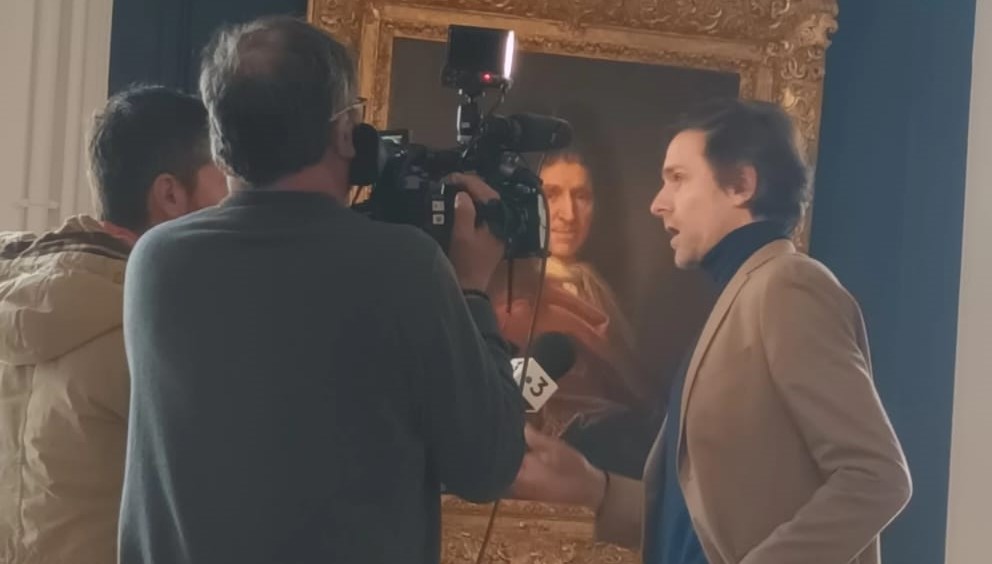
Expertise
A work of art easily loses its identity. Our research skills have led to many fine discoveries, restoring works to their rightful place and enhancing their value.
We offer expertise and advice for both buying and selling.
We also carry out inventories for estate division, valuation, sale or insurance purposes.
For more details on how we work, or for a free valuation from a photograph, please get in touch with us here.