Jeanne DABOS, née BERNARD (1765-1841)
Portrait or self portrait

- Signed lower left ‘(Bernard) fe Dabos’
- Black chalk, sanguine, white highlights on paper
- 54 x 37 cm
- Circa 1790
Ce ravissant portrait aux trois crayons est une œuvre rare et inédite de Jeanne Dabos, née Bernard, élève d’Adélaïde Labille-Guiard (1749-1803) et fille de Jean-Joseph Bernard (1740-1809), Maître écrivain du Premier Empire à qui l’on doit de nombreux portraits à la plume.
Jeanne DABOS, née BERNARD (1765-1841)
Presumed portrait of Marie-Gabrielle CAPET (1761-1818)
Black chalk, sanguine, white highlights on paper
Signed lower left ‘(Bernard) fe Dabos’
54 x 37 cm
Circa 1790
This delightful three-pencil portrait is a rare and previously unseen work by Jeanne Dabos, née Bernard, a pupil of Adélaïde Labille-Guiard (1749-1803) and daughter of Jean-Joseph Bernard (1740-1809), Master Writer of the First Empire to whom we owe numerous pen portraits.
Jeanne Dabos was born in Lunéville in 1765. She exhibited for the first time in Place Dauphine in 1780 at what would be called a few years later the ‘Exposition de la jeunesse’. She married the painter Laurent Dabos in 1788, and the following year exhibited miniatures at the salon in Toulouse, her husband's hometown. She was one of twenty women out of the one hundred and seventy-two artists exhibiting at the Salon of 1791, alongside her master, Adélaïde Labille-Guiard, and her studio colleague Marie-Gabrielle Capet (1761-1818). She subsequently exhibited genre scenes regularly at the Salons from 1802 to 1835.
Known in particular for her portrait of Marie-Antoinette engraved by Phélippeaux, or for her painting of Marat voting the death of Louis XVI kept at the Musée Lambinet in Versailles (Inv. 775), the works of Jeanne Dabos are rare and we know of no other works by her in the three pencils. However, we know from an article that appeared in the Mercure de France in 1787 that she was admired and taken seriously from the start of her career. The author of the article wrote about her: ‘Miss Bernard, of whom I spoke to you last year with praise, deserves it again this year. Two drawings full of wit and finesse, and a portrait in pastel full of grace and expression must make her be seen as a formidable rival by those who are pursuing the same career’ (Mercure de France, 4 July 1787, p. 186).
This charming portrait is a valuable testimony to Jeanne Dabos' talent. Labille-Guiard's influence is perceptible in the model's pose and attitude. Far from being an idealised representation, this portrait, through its finesse and precision, seeks to transcribe the model's features with truth and delicacy.
Although the portraits of Marie-Gabrielle Capet that we know are quite different from each other, most of them are recognisable, as is ours, with its very distinctive upturned nose, round cheeks, curly hair, heart-shaped mouth, small protruding chin and the outer corners of the eyes drooping above which the eyelids appear swollen.
The latter arrived in Paris in 1781 where she became a pupil of Adélaïde Labille-Guiard alongside Jeanne Dabos, but also Victoire Davril and Marie-Marguerite Carraux de Rosemond.
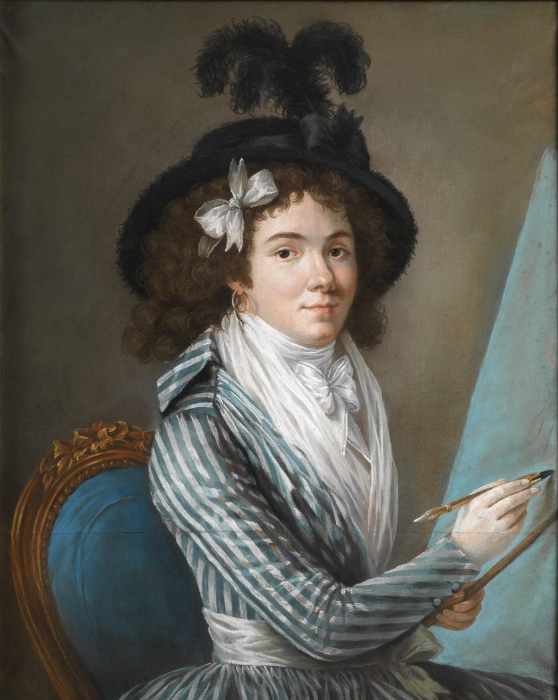
Marie-Gabrielle Capet, Self-portrait, musée Lécuyer
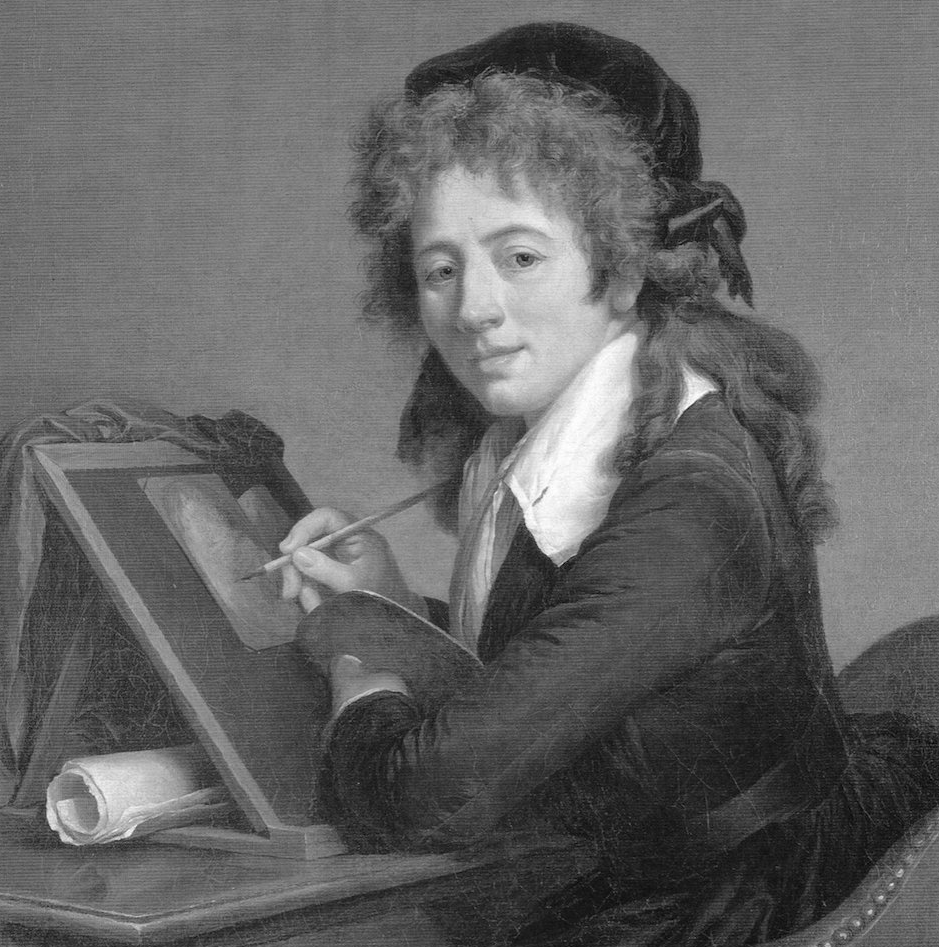
Adelaïde Labille-Guiard, "Citoyenne Capet", 1798